Take a deep breath — and exhale.
Can you feel that small shift in your body? The subtle softening of your shoulders, the quiet pause between thoughts? That moment is more than just air leaving your lungs — it’s release. It’s your nervous system being reminded that it doesn’t have to hold everything all at once.
For many of us, the end of the day is not when things get quieter. Instead, it’s when the mental “to-do list” grows louder. The moment our head touches the pillow, unfinished conversations replay, responsibilities resurface, and tomorrow begins knocking before today has fully ended.
But what if the evening could become something else entirely — a gentle closing ritual instead of a mental debrief?
Why Evenings Feel Emotionally Loud
Throughout the day, we move from task to task, often carrying emotional labour without noticing it. We respond to others, meet expectations, solve problems, and keep going. When the external noise fades at night, the internal voice finally has space to speak.
This isn’t a flaw. It’s simply how the mind processes and integrates experience.
Yet many people meet this moment with self-criticism:
-
I should have done more.
-
I didn’t handle that well.
-
I’m already behind for tomorrow.
Over time, this pattern turns rest into another performance — something we feel we must earn rather than something we deserve.
Offering Yourself the Same Grace You Give Others
Think about how easily you extend compassion to a friend who feels tired or overwhelmed. You might remind them that they did their best, that tomorrow is another opportunity, that rest is not a reward but a necessity.
Now imagine turning that same tone inward.
Self-kindness is not about ignoring growth or avoiding responsibility. It’s about recognizing that effort matters, that being human includes limits, and that recovery is part of resilience.
Sometimes, a few mindful seconds of gentleness are enough to interrupt the cycle of pressure.
An Evening Affirmation Practice
Affirmations are not about forcing positivity. Instead, they can be small anchors — phrases that help the nervous system transition from doing to being.
You might try repeating these words slowly tonight:
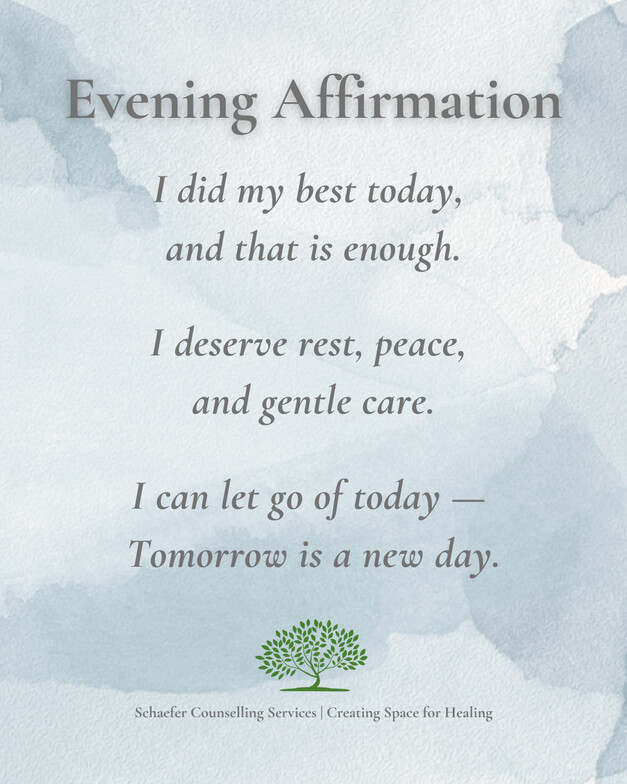
Evening Affirmation
I have done my best today, and that is enough.
I deserve rest, peace, and gentle care.
I can let go of today.
Tomorrow is a new day.
Notice how each line invites closure rather than evaluation. The goal is not perfection; it’s permission.
The Science of Small Moments
Research on mindfulness and self-compassion shows that even brief pauses — a few conscious breaths, a single supportive thought — can shift emotional regulation. These moments signal safety to the nervous system, allowing the body to move toward rest more naturally.
You don’t need an elaborate nighttime routine. Sometimes it’s simply:
-
One slow inhale.
-
One longer exhale.
-
One quiet reminder that today is complete.
Letting the Day End Gently
Rest is not something you have to prove you deserve. It’s a natural rhythm — effort followed by restoration. When you allow yourself to close the day with kindness instead of critique, you’re not giving up on growth; you’re creating the conditions that make growth sustainable.
So tonight, before you close your eyes, I invite you to pause for a moment.
Take a deep breath — and exhale.
Notice the release.
Offer yourself the grace you so freely give to others.
Because sometimes, a few mindful seconds of self-kindness can change not only how you fall asleep, but how you wake up tomorrow.
—Annika

Annika Schaefer
Contact Me