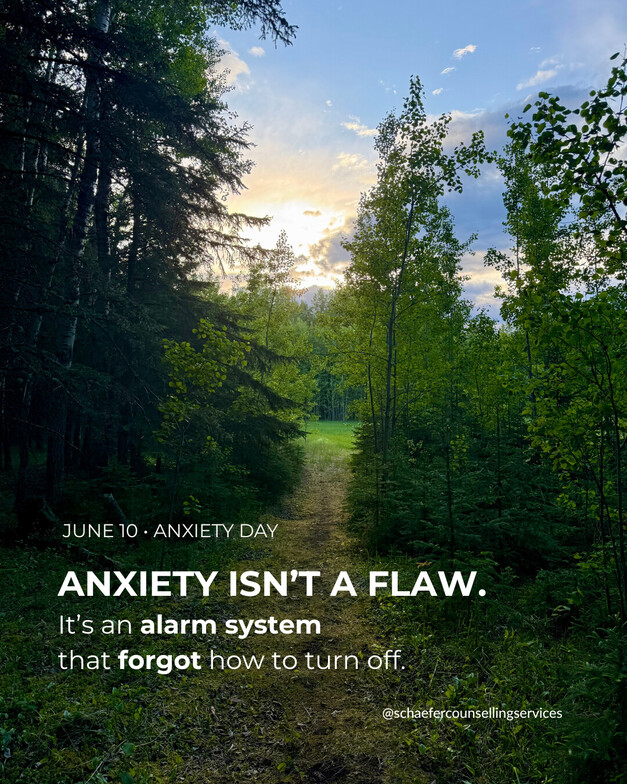
June 10 is Anxiety Day
Anxiety is one of the most common mental health concerns, yet it is often misunderstood. Many people describe it as “worrying too much” or believe it means something is wrong with them. In reality, anxiety is not a flaw—it is an alarm system that has simply not turned off.
Understanding anxiety from a compassionate and informed perspective can help reduce shame and create space for healing, awareness, and support.
Anxiety as a Protective System
Anxiety is one of the body’s natural protective responses. It is designed to keep us safe by scanning for danger, anticipating uncertainty, and preparing us for potential challenges.
At its core, anxiety is not meant to harm us. It is meant to protect us.
It often develops over time in response to life experiences, relationships, stress, and environments where the nervous system has learned to stay alert. In this way, anxiety is not a weakness—it is an adaptation.
When the Alarm System Becomes Overactive
While anxiety begins as protection, it does not always stay balanced.
The difficulty is that anxiety can sometimes continue sounding the alarm long after the threat has passed. When this happens, the nervous system can become overactivated, leaving a person feeling stuck in cycles of worry, hypervigilance, self-doubt, and emotional exhaustion.
It can feel like being constantly on edge, as though something is wrong—even when there is no immediate danger.
This is why anxiety is often described as an alarm system that forgot to turn off.
How Anxiety Can Affect Daily Life
When anxiety becomes persistent, it can impact many areas of life, including:
- Sleep difficulties or restlessness
- Overthinking and difficulty making decisions
- Physical tension or fatigue
- Feeling disconnected or overwhelmed
- Increased self-doubt or fear of mistakes
These experiences are not signs of personal failure. They are signs of a nervous system trying to protect you in the only way it knows how.
Shifting from Judgment to Curiosity
One of the most supportive shifts in working with anxiety is moving from self-criticism to curiosity.
Instead of asking, “What is wrong with me?” it can be more helpful to ask:
- What is my anxiety trying to protect me from?
- What does my nervous system think I need right now?
- What would help me feel safer in this moment?
This approach does not dismiss anxiety. Instead, it acknowledges its protective intention while gently creating space for change.
Supporting the Nervous System
Managing anxiety is not about forcing it to disappear. It is about helping the nervous system feel safer and more regulated over time.
This may include:
- grounding strategies to reconnect with the present moment
- supportive routines that reduce overwhelm
- self-compassion practices that soften inner criticism
- counselling or therapeutic support
- connection with safe and supportive relationships
Healing involves learning how to listen to anxiety without letting it take full control.
You Are Not Alone
If anxiety has been taking up more space in your life, it is important to know that support is available. You do not have to navigate this alone.
Anxiety is not a personal flaw. It is a protective system that sometimes becomes overworked—and with the right support, it can learn to settle again.
—Annika

Annika Schaefer
Contact Me