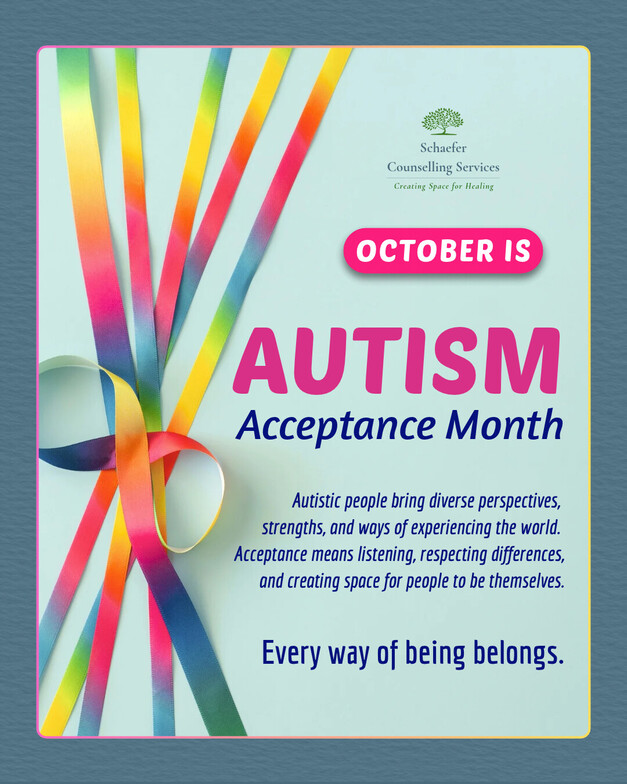
October is Autism Acceptance Month in Canada—a time to learn more about autism, challenge assumptions, and consider what genuine acceptance and inclusion can look like in our everyday lives.
Awareness matters. But awareness is only a starting point.
Acceptance asks us to go a little further.
Autism is not one experience
Autism is a spectrum, and autistic people have diverse strengths, needs, personalities, interests, communication styles, and ways of experiencing the world. There is no single way to be autistic.
Some autistic people may communicate differently, experience sensory information more intensely, or find certain social situations challenging. Others may have strengths in areas such as attention to detail, creativity, deep knowledge of particular interests, pattern recognition, or problem-solving.
And, as with anyone else, an autistic person's experiences cannot be understood simply by looking at a diagnosis.
There is a whole person behind the label.
From awareness to acceptance
Awareness can help us recognize that autism exists.
Acceptance invites us to consider how we respond to difference.
That might mean becoming more thoughtful about the expectations we place on others. It might mean recognizing that communication does not always look the same for everyone. It can mean allowing different ways of participating, connecting, learning, expressing emotions, or navigating the world.
Acceptance does not mean ignoring someone's challenges or support needs. It means recognizing those needs without reducing the person to them.
It also means asking:
What would help this person feel understood, respected, and included?
Making room for different ways of being
Sometimes inclusion happens through small changes.
It may look like giving someone more time to respond rather than assuming they are not listening. It may mean offering different ways to communicate. It may involve being mindful of sensory environments, reducing unnecessary expectations, or simply asking what would be helpful instead of making assumptions.
These things can make a meaningful difference—not only for autistic people, but for many people whose ways of communicating, processing, or experiencing the world do not fit neatly into what is considered “typical.”
There is value in making room for difference rather than expecting everyone to adapt to the same way of being.
In counselling
A counselling space should be a place where people can be understood as individuals—not simply through a diagnosis, label, or set of perceived deficits.
For autistic clients, this can include exploring their own experiences, relationships, emotions, identity, stressors, strengths, and support needs at their own pace.
It can also mean considering whether some of the distress a person is experiencing comes not only from within themselves, but from navigating environments and expectations that may not accommodate the way they experience the world.
A neurodiversity-affirming approach does not mean assuming that every autistic person wants or needs the same kind of support. It means approaching each person with curiosity, respect, and a willingness to understand their individual experience.
Acceptance begins with listening
We do not have to understand every experience in order to respect it.
We can listen without immediately trying to correct, change, or explain.
We can be curious without making assumptions.
And we can recognize that difference does not need to be erased in order for someone to belong.
This Autism Acceptance Month, perhaps the invitation is a simple one:
Listen. Learn. Respect. Include.
Because every person deserves to experience belonging without having to become someone else first.
Every way of being belongs.
Creating Space for Healing.
—Annika

Annika Schaefer
Contact Me