Why emotional well-being doesn’t always mean looking on the bright side
We live in a culture that often encourages us to look for the positive.
Find the silver lining.
Focus on the good.
Everything happens for a reason.
At least it could have been worse.
Sometimes, these perspectives can be helpful. There are moments when finding hope, perspective, or meaning can help us move through something difficult.
But there are also times when being encouraged to “look on the bright side” can feel like the opposite of what we need.
Sometimes, something is simply hard.
And we don't always need to make it positive.
Difficult emotions don't need to be fixed immediately
When we experience grief, disappointment, anger, fear, hurt, or uncertainty, there can be an understandable urge to make those feelings go away.
We may try to distract ourselves, talk ourselves out of how we feel, or quickly search for a more positive way of looking at the situation.
This can be especially true when the people around us are uncomfortable with difficult emotions. They may offer reassurance or encouragement because they genuinely want to help.
But emotional well-being isn't about feeling positive all the time.
Our emotions are information. They can tell us that something matters, that something has been lost, that a boundary has been crossed, that we're overwhelmed, or that we're facing something that feels uncertain or painful.
Making space for a difficult emotion doesn't mean getting stuck in it.
It means allowing ourselves to acknowledge what is happening without immediately demanding that it change.
When positivity becomes pressure
There is a difference between hope and toxic positivity.
Hope can make room for the reality that something is difficult while still leaving room for the possibility that things may become different.
Toxic positivity, on the other hand, can sometimes create pressure to maintain a positive outlook regardless of what we're experiencing.
It can sound like:
“Just stay positive.”
“Everything happens for a reason.”
“Try to focus on the good things.”
“At least...”
The intention behind these statements may be caring. But when someone is hurting, they can unintentionally communicate that their difficult emotions are uncomfortable, excessive, or something they should move past.
Sometimes what a person needs isn't a different perspective.
Sometimes they need someone to acknowledge the perspective they're already living.
“That sounds really difficult.”
“I can understand why you're hurting.”
“You don't have to figure this out right now.”
“I'm here with you.”
Validation doesn't mean agreeing with everything someone thinks or feels. It means recognizing that their emotional experience makes sense in the context of what they're going through.
You don't have to find the lesson right away
There is also a tendency to believe that difficult experiences need to become meaningful.
We ask:
What did I learn from this?
What is this trying to teach me?
How will this make me stronger?
Sometimes meaning does emerge from painful experiences. Over time, we may discover something we learned about ourselves, our relationships, or what matters to us.
But we don't have to find that lesson immediately.
A painful experience can simply be painful.
A disappointment can simply be disappointing.
Grief doesn't need to become a lesson in order to be worthy of compassion.
There can be value in allowing an experience to be what it is before deciding what it means.
Making space is different from staying stuck
Allowing difficult emotions doesn't mean that we should sit in them indefinitely or give up on moving forward.
There is a difference between making space for an emotion and being consumed by it.
Making space might look like:
- Naming what you're feeling without judging yourself for it.
- Allowing yourself to acknowledge that something hurts.
- Talking with someone you trust.
- Taking a break instead of forcing yourself to “be okay.”
- Giving yourself time before trying to make sense of what happened.
- Recognizing that two things can be true at once: something can be difficult and there can still be things you appreciate.
Emotional processing doesn't always happen in a straight line. We may move between sadness and relief, anger and acceptance, hope and uncertainty.
That's okay.
We don't have to choose one emotion and stay there.
Sometimes acceptance comes before change
When we stop fighting with ourselves about what we should be feeling, we can begin to respond to what we are actually experiencing.
That doesn't mean liking what is happening.
It doesn't mean giving up.
It means starting from where we are rather than where we think we should be.
Sometimes the most compassionate thing we can say to ourselves is:
“This is hard, and I don't have to pretend that it isn't.”
From there, we can begin to ask a different question.
Not:
“How can I make myself feel positive?”
But:
“What do I need right now?”
Maybe the answer is rest.
Maybe it's connection.
Maybe it's a conversation.
Maybe it's a boundary.
Maybe it's simply some time and space to let things settle.
And sometimes, what we need is support in making sense of what we're carrying.
You don't have to rush past a difficult feeling
There is nothing wrong with hope.
There is nothing wrong with gratitude.
There is nothing wrong with looking for what is good.
But these things don't have to replace the acknowledgment of what is difficult.
We can hold both.
Something can be painful, and there can still be moments of beauty.
Something can be disappointing, and we can still have hope.
We can appreciate what we have while grieving what we've lost.
We can keep moving forward without pretending that the road has been easy.
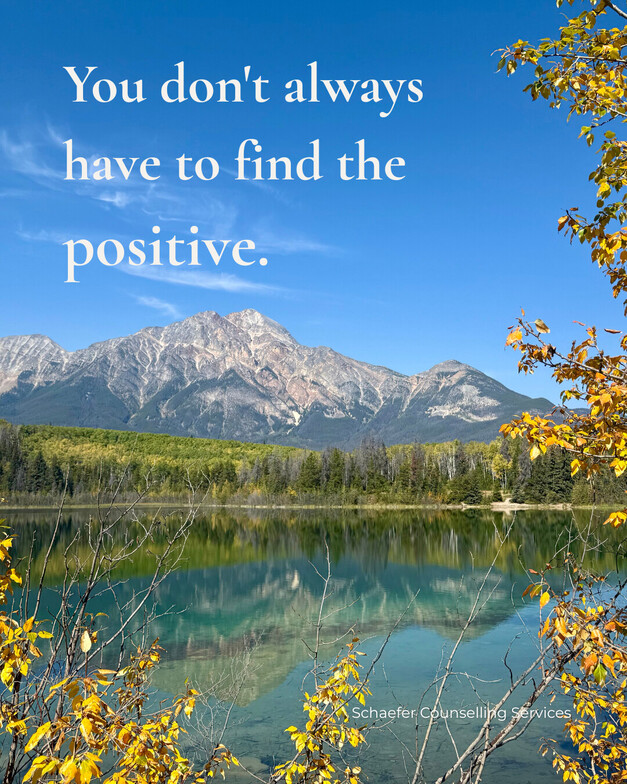
You don't always have to find the positive.
Sometimes, making space for what is real is part of moving forward.
—Annika

Annika Schaefer
Contact Me