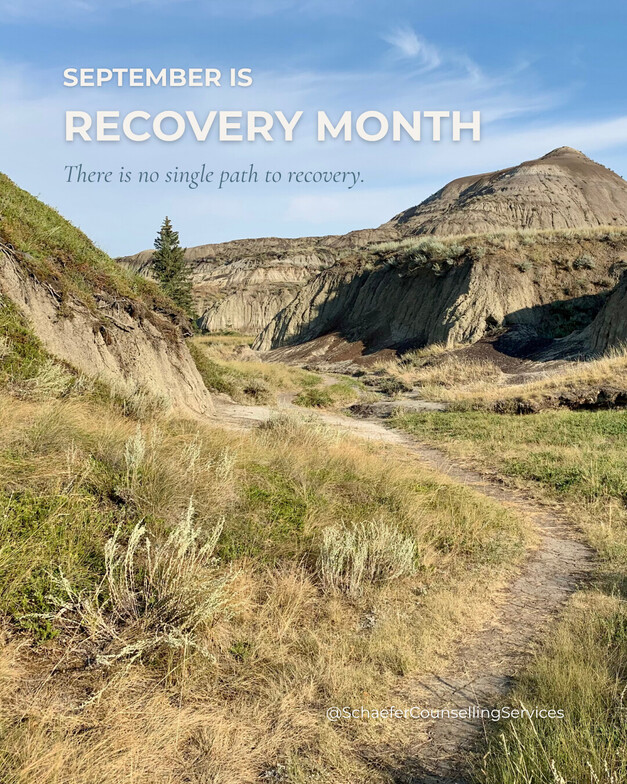
A while back, I took this photo while walking through the Drumheller badlands. I came across it recently, and something about the path winding through the landscape made me pause.
It reminded me that recovery, like so many things in life, doesn’t always follow a straight line.
There can be turns, unexpected stretches, and moments when we can’t see very far ahead — and yet, the path continues.
September is Recovery Month, an opportunity to recognize the many different paths people take toward recovery and to consider how we can respond with greater understanding, compassion, and less judgment.
Recovery Doesn’t Look the Same for Everyone
There isn't one path, one timeline, or one definition of what recovery is supposed to look like.
It can mean finding your footing, reconnecting with yourself, rebuilding trust, learning new ways of coping, or simply taking the next step.
For some people, recovery may mean abstinence. For others, it may involve reducing substance use, reconnecting with relationships, finding stability, or developing healthier ways of coping with difficult experiences.
What matters is remembering that there is a person behind the struggle.
Looking Beyond the Substance Use
It can be easy to focus on the substance itself: What are they using? How often? Why don't they just stop?
But substance use rarely exists in isolation.
Sometimes it develops alongside grief, trauma, loneliness, anxiety, depression, overwhelming stress, difficult relationships, or experiences that have never felt safe enough to talk about.
This doesn't mean that every experience of substance use has the same explanation. It means that understanding the person — rather than reducing them to their substance use — matters.
When we become curious about what someone may be experiencing beneath the surface, we create more room for compassion and less room for shame.
Recovery Isn't a Straight Line
We often like stories of recovery that follow a simple pattern: struggle, change, success.
Real life is rarely that tidy.
There may be progress, setbacks, uncertainty, new beginnings, and periods when someone isn't sure what comes next. A person's relationship with substances can change over time, just as their needs, circumstances, and goals can change.
A setback doesn't erase progress.
And asking for help doesn't mean someone has failed.
Recovery can be a process of learning — about yourself, your needs, your relationships, your patterns, and the ways you've learned to cope.
Compassion Matters
Stigma can make it harder to reach out for help.
When people expect to be judged, shamed, or defined by their past, they may be less likely to talk honestly about what they're experiencing. Compassion doesn't mean ignoring the impact of substance use or avoiding difficult conversations. It means approaching those conversations with humanity.
We can hold both:
Substance use can have serious consequences.
And the person experiencing it still deserves dignity, understanding, and care.
These aren't contradictory ideas.
What Does Support Actually Look Like?
Supporting someone in recovery doesn't require you to have all the answers.
Sometimes it looks like listening without immediately trying to fix things.
Sometimes it means asking, “What would feel helpful right now?”
It can mean encouraging someone to seek professional support, helping them find resources, or simply reminding them that they don't have to navigate everything alone.
And it also means recognizing your own boundaries. Supporting someone doesn't mean taking responsibility for their recovery or carrying everything for them.
You can care deeply about someone while recognizing that their journey belongs to them.
Making Room for Possibility
Recovery Month is an opportunity to look beyond labels and assumptions.
It is a reminder that people are more than the most difficult thing they've experienced.
Change is possible. Support matters. And sometimes the first step isn't knowing exactly where you're going — it's having enough safety and compassion to take the next step.
Recovery doesn't have to look perfect to be meaningful.
And no one should have to earn compassion before receiving it.
If you or someone you care about is struggling with substance use, reaching out for support can be a meaningful place to begin.
—Annika

Annika Schaefer
Contact Me