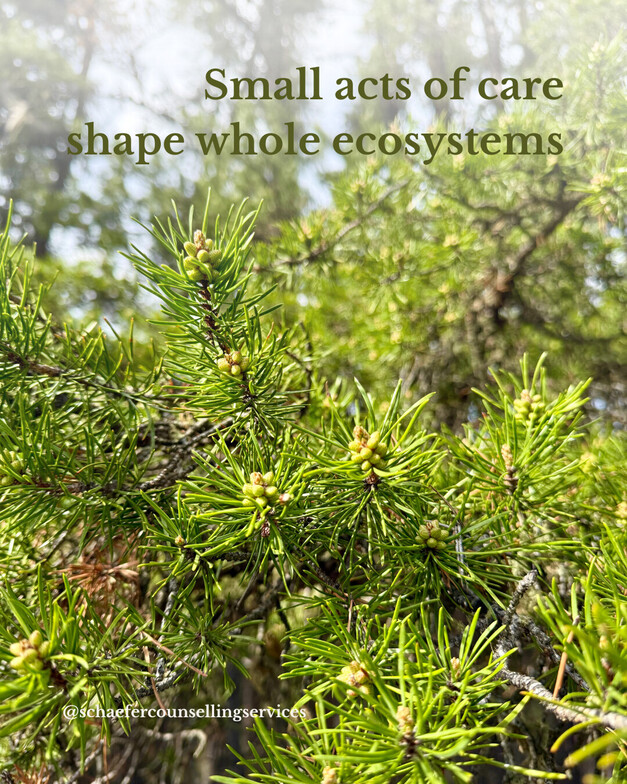
Small Acts, Shared Ecosystems
Today is World Environment Day—a reminder that we are part of something larger, interconnected, and constantly shaped by care or neglect. It invites us to consider not only the environments around us, but the environments we are part of, and the ones we carry within us.
We Are Not Separate from the Environment
When we think of “the environment,” we often think of something external: forests, oceans, air, land, and the physical spaces that surround us. Something separate from ourselves that we observe, use, or protect.
But in reality, we are not separate from the environment. We are embedded within it. And in many ways, we are environments ourselves.
We each carry internal landscapes shaped by the conditions we move through. The spaces we live in, the pace of our days, the relationships we engage in, and the thoughts we return to all contribute to an internal ecosystem. Some parts of that ecosystem feel nourishing and steady. Others can feel depleted, overstimulated, or strained. Most of the time, it is a combination of both.
Mental Health as an Ecosystem
Mental health, like ecological health, does not exist in isolation. It is shaped by context. It responds to conditions. And it shifts depending on what is consistently present over time.
Just as ecosystems require balance and care to thrive, so do our internal worlds.
Sometimes care looks like planting trees, reducing waste, or making choices that reflect a responsibility to the wider world. These actions matter not only for their immediate impact, but because they reflect a way of being in relationship with something beyond ourselves.
Quiet Forms of Care
And sometimes care looks quieter.
It can look like stepping away from overstimulation in a world that rarely slows down. It can look like creating more space in your day or in your environment so that everything does not feel constantly full. It can look like noticing what drains you versus what replenishes you, even in subtle ways. It can look like choosing rest without needing to justify it through productivity or exhaustion.
These are not always the kinds of actions that get recognized as meaningful. But they shape conditions. And conditions shape systems.
Healing as Slow Restoration
Healing, like environmental restoration, is rarely immediate. It unfolds slowly through repeated acts of attention and repair. It is less about dramatic transformation and more about consistent tending over time.
There is something important in remembering this. It challenges the idea that change has to be visible to be real. Often, the most meaningful shifts are almost imperceptible in the moment they happen.
We may not notice when we begin to respond differently. Or when we pause instead of push through. Or when something that once felt overwhelming begins to feel slightly more manageable. But these are also forms of change.
We Are Part of the System
We do not need perfection to make a difference in either system—external or internal. What matters is attention. A willingness to recognize that we are already part of systems that respond to how they are treated.
Because every environment we belong to—both outside and within—responds to care, neglect, and everything in between.
And even small shifts in how we live within those systems can, over time, change the conditions of the whole.
If this reflection resonates and you’re wanting support in tending to your internal environment, you’re welcome to reach out.
—Annika

Annika Schaefer
Contact Me